Highly-Active Anti-Retroviral
Treatment (HAART) can change the life of an AIDS patient totally, who otherwise
would be doomed to die soon. Thus he or she may live for many years and even
decades in real wellness.
Past
Many had to die because they could not
(yet) get the life saving treatment (in those days):
Pioneering AIDS treatment in South Africa
The 1st National AIDS-Conference in South Africa
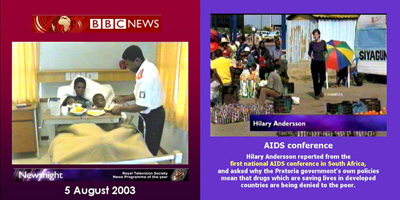
was the occasion that a TV crew from BBC London visited
Blessed Gérard's Hospice and filmed scenes from our palliative care. Hilary Andersson's impressive report on the inequality of access to antiretroviral
medication was broadcast in the BBC Newsnight programme on 5 August 2003 and surely played a role to persuade the South African Government to make a
declaration of intent to roll out antiretroviral medication to the public in future.
Hilary Andersson reported from the first national AIDS conference in South Africa, and asked why the Pretoria government's own policies mean that drugs which are saving lives in developed countries are being denied to the poor.
Hundreds of AIDS-patients are alive today
and they feel well, because they get the life saving treatment in our
AIDS-Treatment Programme:
Vatican Radio:
Interview with Father Gérard on 27 July 2009
Responding to the AIDS problem
in kwaZulu-Natal
Vatican Radio:
Interview with Father Gérard on 27 July 2009 Misinformation about HIV AIDS
Vatican Radio:
Interview with Father Gérard on 27 July 2009 At the forefront of Anti-retroviral Therapy
in South Africa,
the Blessed Gérard's Care Centre.
Festival of Life
on World AIDS Day 2010
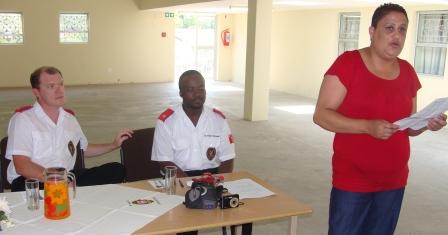
It was
then the turn of one of the patients to speak freely about what she felt about the
HAART Programme and what it is like to live with HIV on a daily basis. Her testimony evoked a lot of emotion
how she is living positively with HIV infection:
"Greetings to you all
My name
is Claudette Louw. I grew up in Mangethe and now I stay in Mandeni. I am 42
years old. I work at Siqumbe (Renckens) where I have worked for 20 years. In
April 2004 I became ill for three months, attending various doctors without
getting better. I was eventually admitted into Stanger Hospital. I would vomit
when trying to eat as I couldn’t stand the smell of food, even the perfume
fragrances.
The
doctors said that I had stomach ulcers and advised me to stop eating tomatoes,
spicy food etc. I was discharged from hospital after being there for two days. I
called my aunt telling her that I was ill but didn’t know what the cause of my
illness was. She made me an appointment with her doctor in Durban.
I
consulted with the doctor; he did an ultrasound and told me that I had ulcers in
my stomach. He referred me to McCord Hospital to have an abdominal X-Ray
performed. I went there and the attending doctor asked me what was wrong and I
told him that I have been diagnosed with stomach ulcers. He advised me to have
an HIV test done before he could continue looking after me. I had the pre-test
counselling where they asked me why I wanted to have the HIV test done. I
explained that I had been ill for three months with no improvement.
I took
the blood test, waited for five minutes, after which the results on a small
piece of paper in a sealed envelope, came back. I hesitated for a while before
eventually opening the envelope. It was written “HIV TEST POSITIVE” and the CD4
count was 254. Tears welled up in my eyes and I thought that my life had come to
its end. I asked for permission, from the hospital, to call my workplace and
they agreed. I called my boss, unable to speak because I was on the brink of
crying. I told her (Mrs Taljard) that I want to commit suicide and she asked me
what the problem was. I told her that I was HIV positive. Her words to me were
“Claudette we love you, think about your child”, at the time my child was 12
years old. I subsequently phoned my aunt to fetch me since I had finished. When
we arrived at home she asked me how it had gone at the doctor’s. I told her,
tearfully, that I had the HIV. She cried because she thought that I was going to
die soon after and I was also crying thinking that I was going to leave this
world.
I went
back home to Mangethe and told my whole family. Their words were that I am not
the first and not the last and that life goes on. I trust that many people know
that the ARVs were not free back then, I had to buy them for R900.00 every
month. My family helped me buy the ARVs for the first five months. They (ARVs)
would make me sick but I continued taking them, it was not easy. I would shy
away from people because I had lost weight having gone from a 36 to a 30 dress
size. In October 2004 I heard that HIV people were being welcomed at Blessed
Gerard’s Hospice. That’s when I started taking ARVs for free and currently my
CD4 count is 1128.
Today I
wish to thank all the people who were helping me at work, at Blessed Gerard’s
Hospice HAART Programme, my family and friends. Their help has made me live my
life to the fullest.
I would
like to end by saying that AIDS doesn’t kill; it is denial that causes one to
die. One more thing is that ARVs clash with traditional medicines and mixtures.
I love
you all.
There
are a lot of people who have been helped, because of me, in my work place. Thank
you."
(Remark: Ms Louw has expressely consented
that her real name, her pictures and her
speech may be published.)
I spent a day travelling with one of the therapeutic counsellors.
This woman has a healthy little girl. Thanks to infection prevention
practices used during the delivery of the child, she did not get HIV
during birth. When a pregnant mother is diagnosed with HIV early enough,
she can begin anti-retroviral therapy and reduce the risk of infecting
her unborn child to a minimum. ...
Two days later we saw this woman and her baby in the hospice waiting area
where the baby waved at us happily.
Our second biggest sponsor,
the US-American Government, reduced their support of AIDS relief in
Africa drastically. This also impacts on the AIDS-Treatment Programme of
the South African Catholic Bishops' Conference (SACBC).
which until now was part and parcel of the Programme of the SACBC, will no
longer be sponsored by the US government through the SACBC after the end of May
2011.
That means that we will have to bridge a financial gap of 3,007,497.00 Rand
(418,035.52 USD / 260,166.07 GBP) per annum.
The grant of the SACBC was an equivalent of 25.83 Rand (3.59 USD / 2.23 GBP)
per patient per day in the last year (2010).
If we take inflation and increased costs into account for 2011, and the fact
that the cancelled grant had not covered all the cost of our AIDS-Treatment
Programme anyway, we have to round up and ask as many people as possible to
"Adopt" an AIDS-patient
requiring
Rand
USD
GBP
per
30
4
3
day
210
28
21
week
920
122
92
month
2.740
365
274
quarter
5.480
730
548
half year
10.950
1.460
1.095
year
in 2011
We are absolutely aware that such amounts supersede the donation budget of
many individuals. Therefore we ask you to get your parish, your society, your
social service or sports club, your school or school class, your group, your
association etc. involved and ask them to adopt one or several of our
AIDS-patients.
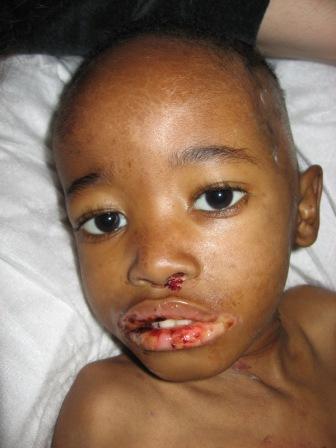
He got a second chance to live, is very happy and a good student at school
because he - as one of hundreds - gets the life saving help through our
AIDS-treatment programme - and he needs this treatment twice a day for the rest
of his life.
Help us to help!
through a donation towards our work.
Please give your bank a stop order!
If you live in South Africa:
You may make a donation directly into our banking
account.
Our banking details are as follows:
Name of Account: Blessed Gérard's Care Centre
Type of account:
Current Account
Bank:
First National
Bank
Account number:
529 4004 0349
Branch:
Mandini
Branch code:
220429
Swift Code: FIRNZAJJ
Please ensure that you put your personal details on the deposit
form
or send the information directly to us, so that we can acknowledge and assign
your donation properly.
If you live in the USA:
Thanks to the generosity of the Benedictine
Mission House in Schuyler, Nebraska, we can now offer you a convenient way
of making donations towards our work, inside the United States, with the
possibility of declaring your donation on your tax return.
Cheques should be made out to
"Benedictine Mission House" with a remark
"Brotherhood of Blessed Gérard" (Please do not forget
this!)
These should then be sent to:
Benedictine Mission House
P.
O. Box 528
Schuyler, Nebraska 68661
People who have made a donation of more than $200 will receive a
tax certificate immediately from the Mission House and donors of smaller amounts
would receive one at the end of the tax year, if they want to declare their
donations on their tax returns.
~~~~~~~~~~~~~~~~~~
Or donate online:
If you live in Great Britain / United Kingdom:
You may send a cheque:
Please make the cheque out to “BASMOM Foreign Aid Service”, attach a note, that the donation is meant to support the Brotherhood of
Blessed Gérard and send it to this address:
The Hospitaller BASMOM,
Mr Tim Orchard Layer Breton Lodge
Layer Breton
Colchester CO2 0PP
You may deposit your donation directly into the
banking account of the BASMOM
and mark it for the Brotherhood of
Blessed Gérard:
Name of Account: BASMOM
Foreign Aid Service Bank: HSBC Bank plc,
Pall Mall, London Account number: 61260561 Sort/branch code: 40 05 20
I am convinced that we may reach our donation target if many will contribute.
I refuse to abandon hope and I trust that we will be in a position to
continue the life saving treatment of hundreds of AIDS-patients whose survival
depends on our support.








 "Greetings to you all